Wwise Audio Implementation Services That Hold Up

Updated: Oct 7
A vertical slice can survive placeholder audio. A cert submission cannot. That gap is where wwise audio implementation services either protect a production or quietly introduce risk - voice starvation on lower-memory SKUs, broken switch logic after a design revision, interactive music that reads well in a review but collapses under runtime pressure.
For senior audio directors, XDEV managers, and producers, implementation is not clerical work. It is systems design inside a moving target. The value is not simply wiring events to assets. It is translating narrative intent into runtime behavior while staying inside memory, CPU, loudness, version control, and milestone constraints.
What wwise audio implementation services actually cover
At the premium end of external development, implementation starts well before the first Event is posted in engine. The first question is structural: what kind of audio system does the project need to remain stable through content growth, engine updates, and late-stage gameplay changes? A combat system with layered states, side-chain ducking, and dense Foley turnover has very different requirements than a narrative title built around sparse spatial storytelling and dialogue priority.
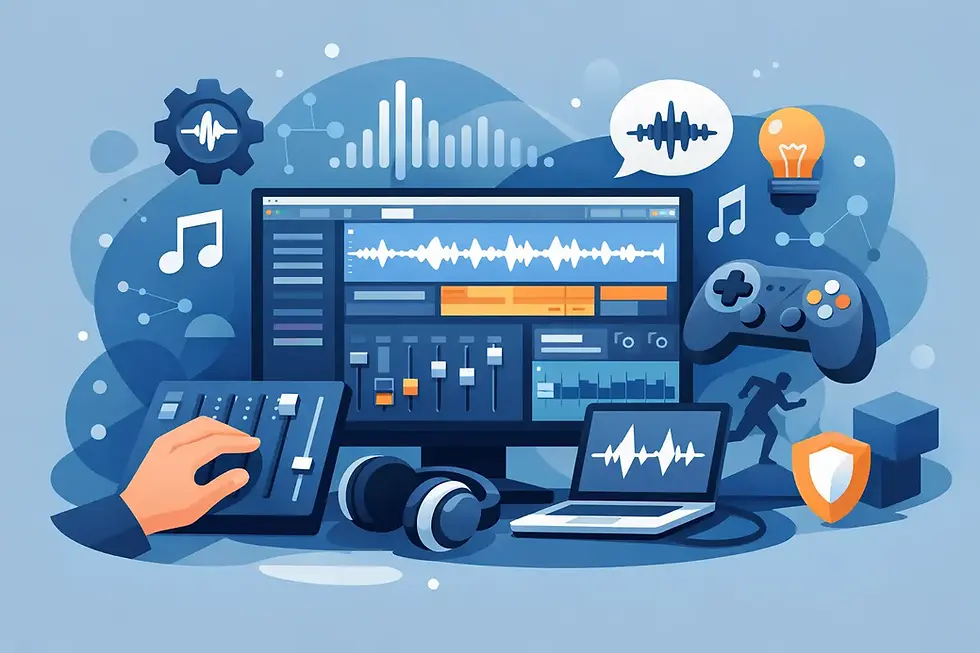
In practice, wwise audio implementation services should cover authoring architecture, event taxonomy, State and Switch design, RTPC mapping, bus topology, HDR strategy, loudness management, memory planning, and in-engine integration. If the provider stops at “the sounds are triggering,” the production still carries most of the actual risk.
A credible implementation partner also works where problems usually appear: SoundBank strategy, streaming granularity, platform-specific compression, seek tables, voice limiting, and profiler-based diagnosis. These are not edge cases. They are the routine sources of rework during alpha and content lock.
The production friction implementation is supposed to remove
Most teams seek external support because internal bandwidth is constrained. The deeper reason is usually that implementation has become a dependency bottleneck between design, code, and audio. When that happens, iteration slows down in ways that are easy to underestimate.
A common pattern looks like this. Audio delivers polished assets, but event naming is inconsistent with engineering conventions. Switch Containers mirror an outdated gameplay taxonomy. Dialogue priorities were tuned in editor but never pressure-tested against the real voice count limit in combat. Then a milestone build reaches QA and everyone discovers the mix problem is actually an architectural problem.
Strong wwise audio implementation services remove that friction by making the runtime system legible to all disciplines. Designers understand what parameters they can safely expose. Engineers know how the integration behaves under load. Audio can revise content without breaking dependency chains or generating avoidable bank churn in Perforce.
This matters even more in distributed teams. If your gameplay programmers are in Montreal, production is in Los Angeles, and the external audio team is operating from CST, real-time overlap is not a convenience. It directly reduces turnaround on integration bugs, profiler reviews, and milestone triage.
Wwise audio implementation services for AAA and AA pipelines
In AAA and AA production, implementation quality is visible in the profiler long before it is visible in a marketing capture. The wrong external partner can deliver content that sounds expensive in isolation and performs poorly in context.
Consider interactive music. The creative brief may call for fluid transitions between exploration, stealth, pursuit, and combat, with harmonic continuity preserved across branching states. That is straightforward conceptually. The implementation challenge is making those transitions sample-accurate enough to feel authored while still accommodating gameplay volatility. If the transition logic is too rigid, design loses responsiveness. If it is too permissive, the score sounds indecisive and the dramatic line weakens.
The same trade-off appears in SFX systems. Rich layering improves materiality, but every additional layer competes for voice count and memory. Spatialization improves positional clarity, but not every sound benefits equally from full 3D treatment. Some assets should be prioritized for readability, others for scale, and many should collapse to simpler behavior at distance or under mix stress.
This is why profiler-led implementation matters. A mature team reviews virtual voice behavior, bus peaks, streaming activity, and CPU spikes in target gameplay scenarios - not only in curated editor tests. Decisions about attenuation curves, actor-mixer hierarchies, and playback limits should come from runtime evidence, not preference alone.
The technical markers of a serious implementation partner
There are a few signals experienced buyers should look for immediately. The first is whether the provider can discuss the relationship between narrative design and system design without treating them as separate conversations. If a partner cannot explain why dialogue ducking logic needs to change because your game shifted from intimate two-character exchanges to squad-based radio congestion, they are implementing assets, not building a mix strategy.
The second signal is pipeline literacy. Wwise implementation inside Unreal or Unity is rarely difficult at the surface level. The real question is how the team behaves under production conditions: branching in Perforce, bank generation discipline, build validation, naming governance, and change tracking across agile sprints. External teams cause expensive delays when they ignore source control etiquette or submit work that cannot survive a merge-heavy milestone cadence.
The third signal is platform awareness. A partner should be able to speak concretely about dynamic range targets, codec choices, speaker format considerations, and compliance downstream. If a title must ship with cinematics, localized dialogue, and possible Dolby Atmos deliverables for promotional or narrative components, implementation cannot be isolated from final mix and technical delivery requirements.
In our own work, this usually means discussing Wwise and post-production in the same meeting. The runtime mix, the linear mix, and the delivery spec affect one another more than many productions assume.
Where film producers should pay attention
Not every search for wwise audio implementation services comes from games alone. Producers managing hybrid productions, transmedia rollouts, or interactive installations often inherit game-audio complexity without game-audio staffing. In Ibero-LatAm co-productions, there is an additional layer: budget scrutiny, spend traceability, and delayed disbursement cycles tied to public funds or treaty structures.
That reality changes vendor selection. A technically sophisticated partner should still understand milestone billing, auditable documentation, and how to package deliverables so they satisfy both production and financial oversight. If implementation work touches multilingual assets, M&E preparation, or interactive exhibition formats linked to a festival or market presentation, the handoff must remain clean under revision pressure.
This is not a niche issue. A late narrative change that affects dialogue logic can trigger re-export, re-integration, and bank rebuilds across languages. If the implementation architecture was not planned for localization, the cost lands at exactly the wrong moment in the financing cycle.
What good implementation looks like inside the build
Good implementation rarely announces itself. The signs are operational. Events are named predictably. Music transitions feel intentional but responsive. Dialogue remains intelligible under combat load. Memory use scales sensibly across platforms. The mix does not depend on manual heroics every time design changes encounter density.
Under the hood, there is discipline. RTPC ranges are calibrated against actual gameplay values rather than arbitrary sliders. Side-chain ducking is selective, not global. Switches reflect gameplay logic instead of forcing audio to compensate for unclear system design. SoundBanks are segmented to support patching and load behavior, not merely organized by department preference.
Even simple code review can reveal maturity. A clean call structure such as `AkSoundEngine.PostEvent("PlayFootstepConcrete", gameObject);` is not impressive on its own. What matters is the surrounding design - when that event should collapse to a material group, how surfaces map from engine physics to Wwise Switches, and what fallback behavior protects the build if a content reference changes late.
Why timezone alignment is not a soft benefit
Senior teams already know that external support fails more often in communication than in craft. Audio integration issues are cross-disciplinary by nature. They involve design intent, engine behavior, and runtime evidence. If the external team reviews a profiler capture while your engineers are asleep, every issue gains a day.
A CST-based partner working in real-time overlap with North American production can join standups, review a broken vertical slice before lunch, and return corrected banks or integration notes the same day. For European stakeholders, the overlap is still workable for approvals and escalation windows. That operational rhythm is one of the few external development advantages that compounds across every sprint.
The point is not convenience. It is risk compression.
Buying for durability, not temporary relief
When evaluating wwise audio implementation services, the right question is not whether the team knows Wwise. Many teams do. The useful question is whether they can protect your project from the specific failures that emerge when creative ambition meets runtime limits, milestone pressure, and multi-studio coordination.
A partner worth retaining will challenge assumptions early. They will tell you when a music system is overbuilt for the design, when a voice budget is too optimistic for target hardware, or when localization plans should change the event structure now rather than at content lock. That candor is more valuable than fast labor if your goal is a production that stays coherent all the way to submission.
The best implementation work is felt as momentum. Design iterates faster, audio remains narratively precise, engineering loses fewer cycles to avoidable cleanup, and production can trust that the sonic layer will hold when the rest of the build gets difficult. That is the standard to buy against.


Comments