The Combat Music Crisis: Moving Beyond Stereo Loops in Indie & AA Games

Updated: Oct 13
If you are an ambitious Indie or AA developer building an action-RPG or a combat-focused game, you know the struggle of trying to make your encounters feel epic.
You hire a brilliant composer, and they deliver a phenomenal combat track. But when it comes time to implement it, your internal team defaults to the easiest solution: they set up a trigger box. When the player enters the room, the Exploration_Loop.wav fades out over 3 seconds, and the Combat_Loop.wav fades in.
It feels jarring, disconnected, and fundamentally amateur. A basic volume crossfade ignores musical tempo, key signatures, and rhythmic downbeats. In 2026, players expect the soundtrack to react directly to their gameplay.
(Disclaimer: Arcella Sound was not involved in the development of the games analyzed below. We highlight the brilliant interactive music systems of AAA titans like Doom Eternal and God of War: Ragnarök to illustrate the advanced Wwise middleware architecture we build for our ambitious Indie and AA clients).
To elevate your project from feeling like an indie game with a background playlist to a AAA cinematic experience, you need an External Development (XDEV) partner that understands Interactive Music Systems.
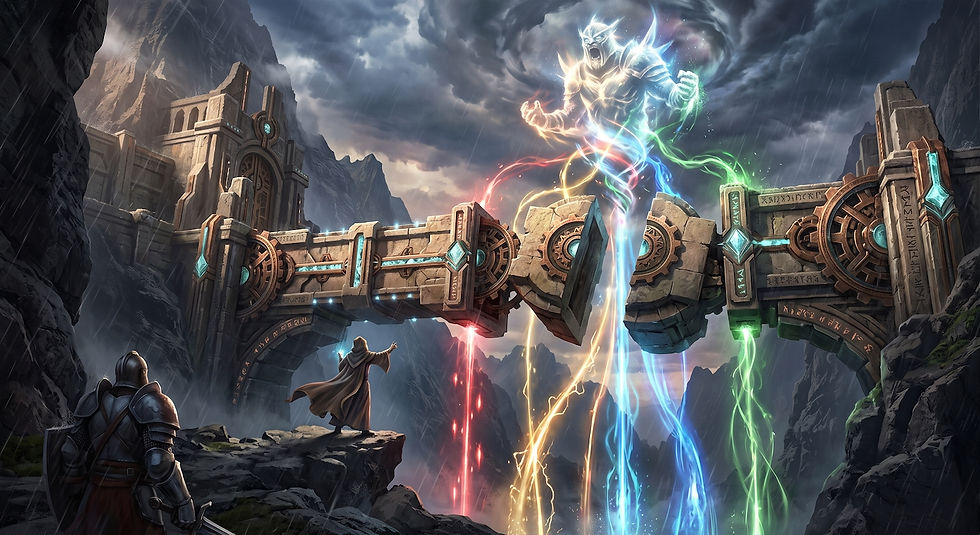
The Flaw of the Crossfade
When you crossfade two un-synced stereo files, you create a "musical car crash." The tempos clash, the frequencies bleed into each other, and all emotional momentum is lost.
True interactive audio requires decoupling the music from a single stereo file and rebuilding it inside middleware (like Wwise or FMOD) using two primary architectures: Horizontal Sequencing and Vertical Layering. Let's analyze how the giants do it.
1. Horizontal Sequencing: The Doom Eternal Benchmark
id Software’s Doom Eternal is widely regarded as a masterclass in aggressive, systemic combat music. The music never crossfades clumsily; it pivots mathematically.
Sync Points and Transition Matrices: Instead of long tracks, the composer delivers the music in short, modular blocks (e.g., Intro, Verse, Build-up, Chorus). Inside Wwise, these blocks are placed into a Music Playlist Container.
The Logic Tree: We architect Wwise transition rules so that if the player triggers a "Glory Kill," the engine sends a State change. The Wwise system does not immediately cut the audio. It waits exactly for the next musical beat or bar (the sync point) and fires a perfectly timed transitional drum fill that seamlessly lands on the downbeat of the high-intensity combat loop. It turns the game engine into a live DJ, ensuring that every transition is musically flawless.
2. Vertical Layering: The God of War: Ragnarök Benchmark
In Santa Monica Studio’s God of War: Ragnarök, boss fights are monumental multi-phase endurance tests. The music needs to scale smoothly as the fight progresses without constantly restarting the tempo.
RTPC Stem Routing: The solution is Vertical Layering. The composer writes one massive track but delivers it separated into stems (Percussion, Low Strings, Brass, Choir, Synth).
Mapping Telemetry: To build this for an AA client, we map game telemetry directly to these stems. We link the Boss_Health float variable to a Wwise Real-Time Parameter Control (RTPC). As the boss’s health drops from 100% to 50%, the RTPC curve dynamically raises the volume of the Brass and Choir stems in real-time. The track doesn't change; it organically swells in intensity, reacting viscerally to the player's progress.
XDEV Management and Team Assembly
Architecting these complex music hierarchies is not a job for a standard composer. It requires a highly specialized pipeline.
As a dedicated XDEV audio partner, we do not just hand you files. At Arcella Sound, we direct the entire audio pipeline. Operating in the CST timezone, we assemble the precise technical teams needed for your project—bridging the gap between the composer's stems and your engine's logic. We manage the middleware architecture, ensuring these advanced Wwise transition matrices are built efficiently and integrated synchronously into your repository.
You bought a great soundtrack. Don't ruin it with an amateur implementation. Review our XDEV game audio pipeline booklet to learn how we manage and architect systemic music for AA development.


Comments